

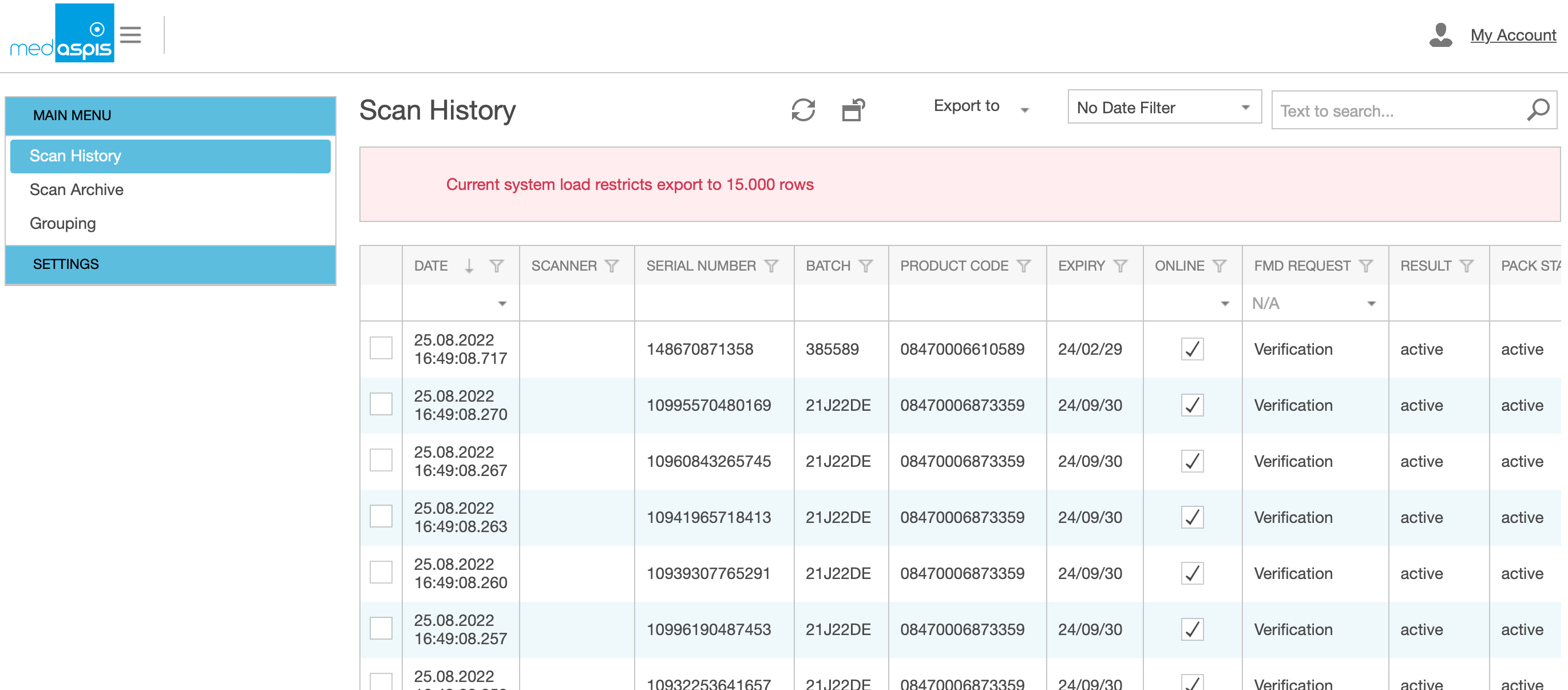
The Scan History always starts with the preset filter “Today”, so only the scans from the same day are displayed. The list may then be empty if no scans have been performed on that day. The desired period can be selected by simply changing the drop-down menu. The setting “No Date Filter” shows all entries in the scan history. If other time filters are to be used, the filtering of the date in the date column is available at any time.

Sorting each individual column of the Scan History table is possible by clicking on the respective column header. The sorting is indicated by an arrow symbol to the right of the column title. Clicking again reverses the sort order.
The default setting is sorting by date. The most recent entry is displayed at the top.
The data sets can be filtered as required, all filters can be combined. Each column has a funnel symbol next to the heading. Clicking on the funnel symbol displays a window with which a filtering of the corresponding column can be carried out.
The date can be narrowed down with start and end date. A specific serial number can be filtered, a specific expiry date, a specific pack status, etc.
Set filters can be deleted by clicking on the “Clear” function at the bottom right of the screen.

Directly under the table headings, you will find a direct search function for most columns. In the case of predefined column contents, the contents can be selected directly via an expanding context menu.
Combinations of filters in different columns are possible. The selected search filters are summarised in text form in the sub-line and can be completely cleared again at any time by clicking on the word “clear”.
Attention: Only those columns can be searched, sorted or filtered for which this option has a practical use. Otherwise, the column search is not available.
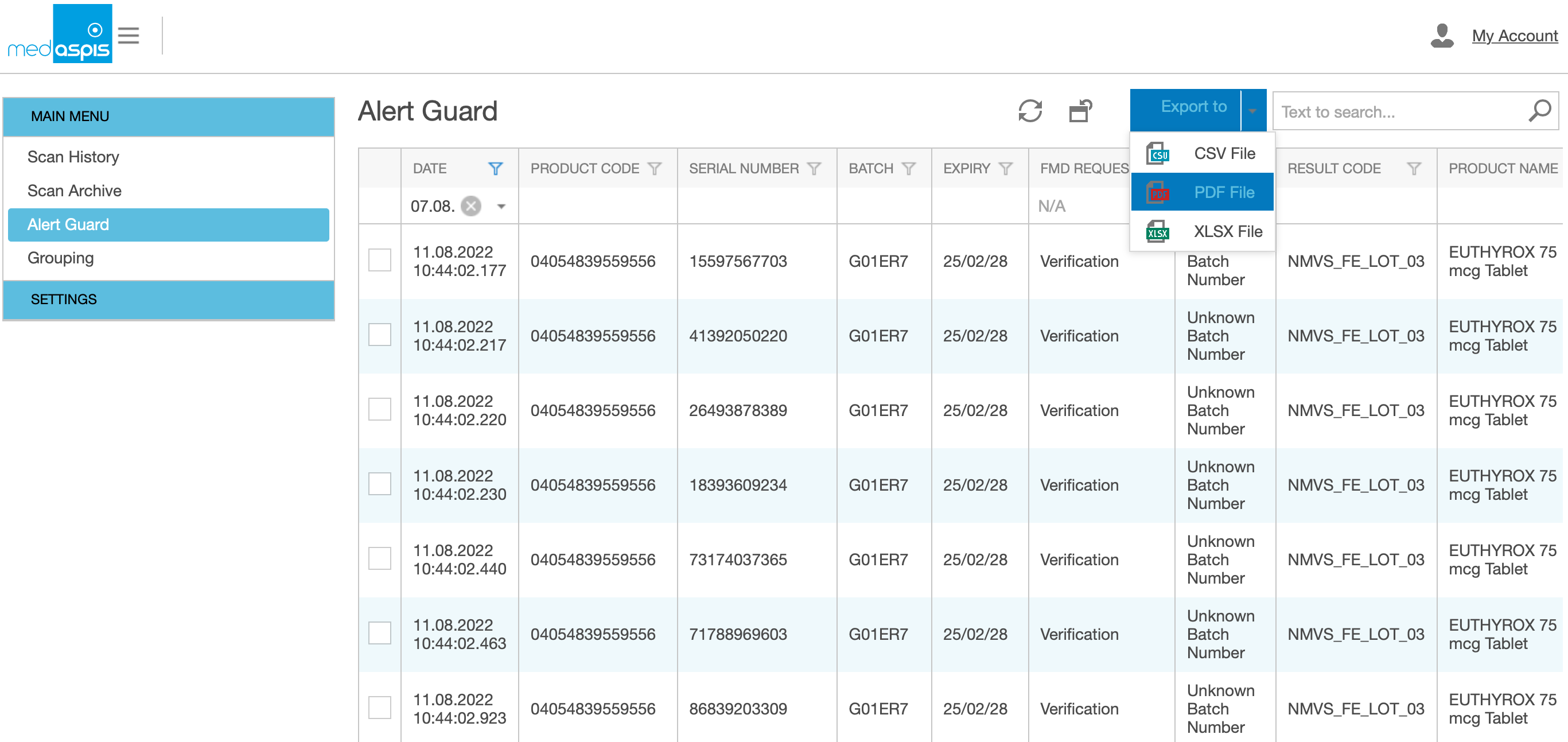
The selected and filtered data can be exported. All displayed parameters (displayed columns) and entries (displayed rows) can be exported from the system to CSV, XLS, XLSX and pdf formats. The data is provided via the download function of the browser.
If the number of records to be downloaded exceeds the technical capacity of the system, the export will not be car-ried out; instead, a short note will appear with the corresponding information.
All additional information can be displayed for each individual scan by clicking on the respective line.

If the handheld device does not have a direct Internet connection during operation, the data is temporarily stored for this time and immediately uploaded to the server as soon as the Internet connection is available again.
The data is displayed in the scan history and marked as offline (not online). With the filter functionality of the table column, all offline scans can be found and displayed immediately.

It is not known to the system whether these offline scans should be sent to the NMVS or not. Only the user knows if another scan has been made in the meantime or if the offline scan was made so long ago that it has been obsolete in the meantime.
For this reason, the entries marked as offline in the scan history must be activated individually and manually. To do this, click on the relevant line and scan the 2D matrix code with a hand scanner. With this information, the content concerned can be processed. The scan creates a new entry in the scan history.
If there are several offline entries to be processed, you can easily switch to the next entry in the detail view by clicking the next button. If the offline filter was previously activated, only offline scans are included in the detail views.
The context menu can be opened by clicking the right mouse button on the table heading. The following functions can be started:
Sort Ascending, Sort Descending: The selected column can be displayed sorted.
Hide Column: The selected column is removed from the table.
Column Chooser: An additional menu is displayed on the right side of the page. All columns are listed that can be displayed in addition to the existing overview. To activate one of these columns, move the desired column title from the displayed list with the mouse and insert it into the table at the desired position. The table will then always appear in this modified view.
Filter Row: With this function the search field of the columns can be shown or hidden.
Footer: An additional blank line is displayed below the displayed rows. In this line, another context menu can be acti-vated by clicking the right mouse button again. In this menu, for example, a counting function can be activated. The number of lines currently selected is then displayed.


medAspis Lean FMD covers all requirements for connecting your company to the NMVS responsible for you for the purpose of falsification checks in accordance with the EU Falsification Directive 2011/62/EU and Delegated Regulation (EU) 2016/161.
And much more…
The mobile FMD Speed Scanner is extremely user-friendly with its touchscreen and is full of surprises. Here are some of its features explained:

Scanning continues even without internet. Codes are stored and processed later.

Monitors batches and products in real time and reports deviations immediately.

The scanner stops instantly on error. Scanning continues only after confirmation.

A control number shows missing packs instantly. Just rescan the last row – everything is recorded.

The scanner scans while the server verifies in the background for maximum speed.

Duplicate scans are detected and filtered automatically – no manual checks required.
Das medAspis Lean FMD System ist das Gehirn hinter dem FMD Speed Scanner. Hier werden alle Scan-Ergebnisse gesammelt und weiter verarbeitet.

PIN-protected profiles control access and allowed FMD functions securely.

All scan data is available for further processing and export.

System interface and NMVS messages are displayed in your local language.

Packs, cartons and pallets are logically and transparently linked.

Aggregations can be shared easily or provided to customers.

Groupings with a unique aggregation code for secure processing.

Links packs with delivery note, customer or carton.

Original codes and full NMVS responses are stored completely and permanently.

Web service interface for direct access to all system data in JSON format.

All scan data is archived for at least five years.

Verification is performed directly at scan via NMVS with instant feedback.

Custom reports by product, batch or time period.

Complete overview of all FMD activities as an audit trail.

Central system control with access to all data.
mit medAspis Lean FMD können Sie auf kritische Fälschungsalarme reagieren. Fehlalarme werden verhindert, die übrig gebliebenen kritischen Fälle werden sicher erkannt und können verarbeitet und dokumentiert werden.

Expert support for all questions related to counterfeit alerts.

Structured documentation of all critical alerts.

Clear instructions for operators and supervisors in every alert case.

All critical alerts clearly displayed in the control panel.

All critical situations explained clearly at a glance.

Additional verification before decommissioning returned packs.

Zeitfenster bis zu 2 Stunden – ideal für Pausen und Schichtwechsel.
medAspis Lean FMD is used throughout the entire pharmaceutical distribution chain, from the manufacturer to the wholesaler to the local pharmacy or hospital. Parallel distribution also relies on medAspis due to its high throughput.
We are proud to present some typical applications used by our customers. If you have any other ideas, please contact us. We can make almost anything possible.
Here in the FMD Briefings, we explain how medAspis Lean FMD can be usefully integrated into your daily workflow.
And how to transfer Data into the own IT landscape.

A leading pharmaceutical logistics provider uses medAspis Lean FMD because of its high scanning speed and flexibility. Fully integrated into the WMS, including the customer’s own scanner, the FMD process runs seamlessly in operation.
Our customer is one of Europe’s largest pharmaceutical logistics companies. medAspis Lean FMD was chosen for its extremely high scanning speed and flexibility.
medApsis Lean FMD is fully integrated into the customer’s own WMS; the entire FMD process runs seamlessly in operational mode and is controlled entirely by the WMS.
Even the scanning process is carried out using customer-certified handheld scanners, with the medAspis software specifically adapted to ensure a consistently high scan rate.

Omeprazole is over-the-counter, but subject to FMD. Through medAspis aggregation, wholesalers scan these medicines in advance. This keeps processes fast, FMD-compliant and cost-effective.
Our customer is a mail-order pharmacy that exclusively sells over-the-counter medicines, including omeprazole. Although available without a prescription, omeprazole is subject to FMD requirements. Due to low demand, the necessary scanning process places a strain on the pharmacy’s highly optimised operations.
To increase efficiency, the pharmacy obtains omeprazole in bulk via the medAspis aggregation system. The wholesaler scans the packs in advance, delivers them in bulk and labels the boxes with a medAspis aggregation label. Upon receipt of the goods, the pharmacy simply scans this label and the packs inside are automatically deactivated in accordance with FMD regulations.
As a result, omeprazole can be integrated into the mail-order pharmacy’s regular processes without individual scanning. Aggregation has only a minimal impact on wholesalers and significantly simplifies pharmacy processes – with a clear cost advantage.

For internal transport, medAspis aggregation enables rapid FMD verification in goods receipt. One scan replaces thousands of individual scans – securely, quickly and without re-entry.
Our customer operates branches throughout Europe. Internal goods movements are also subject to FMD verification. The medAspis aggregation system enables considerable time savings.
The packs are scanned in the outbound warehouse and stored in the Lean FMD system. When goods are received in other countries, the data is retrieved from the shipping carton or pallet using an aggregation code – without the need for rescan.
Aggregation works across all packaging levels: medicine pack, carton and pallet. A single scan of the pallet label captures all contained cartons and packs, replacing thousands of individual scans. The aggregation code is transport-secure and cannot be used by third parties.

A parallel distributor uses medAspis for FMD verification and batch control in a single scanning process. The FMD Speed Scanner automatically stops when the target quantity is reached – for complete and batch-pure bundling.
Our customer operates in parallel distribution in Southern Europe and purchases medicines from pharmacies and wholesalers. The packages are assembled into batch-pure bundles on an order-by-order basis and delivered to parallel importers in Northern and Western Europe.
medAspis enables simultaneous FMD status verification and automatic batch control in a single scanning process. The target quantity is defined in the control panel, and the FMD Speed Scanner automatically stops when the target quantity is reached. This ensures that the correct number of identical products and batches are always delivered.

A parallel trader uses medAspis Lean FMD for secure destruction. Save Dispense first checks the status and only deactivates active packages – this prevents false alarms and suspicion of counterfeiting.
Our customer is active in parallel distribution and specialises in narcotics. These are subject to particularly strict regulatory requirements and must be sorted out and destroyed more frequently than average – including FMD deactivation.
Since many packs have an unknown FMD status, incorrect deactivation quickly leads to reports of suspected counterfeiting. With medAspis Lean FMD and the save-dispense function, the current status of each pack is checked first. Active packs are correctly marked as destroyed, while those that have already been deactivated remain unchanged. This prevents false reports.
The integrated reports enable customers to document all processes transparently for the supervisory authorities.

A parallel distributor transfers FMD scan data directly into SAGE via aggregation. All serial numbers are imported automatically – for reporting and customer communication.
Our customer operates in parallel distribution and transfers all relevant FMD scan data into the SAGE ERP system for further processing.
To achieve this, the customer uses Lean FMD’s aggregation function. All serial numbers are scanned and aggregated at goods-in. In a second step, the SAGE system scans the aggregation codes on the carton labels and retrieves the data via the Lean FMD interface. All serialization data is automatically transferred into SAGE for reporting and customer information.

A parallel importer uses serialisation to assign each pack to a customer. Returns are only accepted if the delivery was previously made to that specific customer.
Our customer is a parallel importer that delivers directly to pharmacies. The high-priced products are scanned and serialised before shipping and clearly assigned to a customer.
In the case of returns, checks are carried out to ensure that the pack was actually delivered to this customer beforehand. Only confirmed deliveries are accepted as returns; otherwise, acceptance is refused. This reliably prevents misuse and false returns.

An international generic drug manufacturer supplies German hospitals with data accompanying the goods. medAspis provides hospitals with the aggregation module free of charge.
Our customer is an international generics manufacturer. For supplying German hospitals, an aggregation process compliant with the German “accompanying data delivery” regulation has been implemented. Hospitals receive already serialized packs and no longer need to scan them.
As many hospitals are not yet able to use aggregation systems, medAspis provides its aggregation module free of charge so they can also benefit from scan-free deliveries from this manufacturer.

A Spanish wholesaler supplies ambulances with medicines via affiliated pharmacies. The logistical process is simplified through aggregation.
Our customer is a Spanish wholesaler supplying prescription medicines to on-site medical units via a network of local pharmacies, in line with national regulations.
With the introduction of the Falsified Medicines Directive, pharmacies would normally need to scan and deactivate each pack individually. To reduce this workload, the wholesaler delivers pre-scanned, aggregated shipments. Pharmacies only scan the aggregation code on the carton, and all contained packs are automatically and FMD-compliantly deactivated.

A Polish wholesaler uses medAspis Lean FMD for hospital aggregation. A single scan automatically transfers and deactivates all serial numbers – a simple process and an advantage in tenders.
Our customer is a Polish wholesaler using medAspis Lean FMD to provide aggregated codes for hospital deliveries. In Poland, hospital supply contracts are awarded via tenders, where offering aggregation is a strong competitive advantage.
With aggregation, hospitals no longer need to fully scan deliveries. They simply scan the carton aggregation code, and all serialization data is automatically transferred and deactivated. The medAspis system is already widely used in Poland by leading wholesalers.

A French exporter uses medAspis for aggregation. A scan of the aggregation label marks all packs as exported – if they are canceled, they can be reactivated by scanning them again.
Our customer is a French exporter supplying EU-approved medicines to Africa. The French packaging can be used directly in many African countries without relabeling.
The products are often sourced from other wholesalers and are scanned and verified at goods-in. medAspis stores the serialization data and aggregates each carton with an aggregation label. At export, a single label scan marks all contained packs as exported. If a deal is canceled at short notice, the packs can be reactivated by scanning the label again.

A Spanish spot trader delivers pre-scanned goods with an aggregation code. A scan automatically transfers all serial numbers of a pallet to the customer’s system – quickly, completely and without individual scans.
Our customer is a Spanish spot trader acting as an intermediary and leveraging price differences within the domestic market. To make his goods more attractive, he pre-scans all packs and transmits the serialization data together with the physical shipment.
At goods-in, the customer only needs to scan the aggregation code on the pallet. This automatically transfers all contained serial numbers into the customer’s system — carton by carton, pack by pack. A single code is sufficient for the entire pallet.

A parallel importer uses Lean FMD for goods-in verification and re-serialization. High-speed scanning, batch control, ERP integration and OBP registration ensure secure and efficient processes.
Our customer is a parallel importer. We support two key processes.
At goods-in, packs are verified, counted, and checked for batch consistency using high-speed scanning. Scan orders are loaded into our FMD system from Microsoft Dynamics Navision. Only if all data matches are the orders closed and transferred to the ERP. Before production, the data is verified again based on the stored records — without rescanning.
In the second step, all decommissioned packs are assigned new national serial numbers via labels. The packs are scanned per order and the new serials are registered via the onboarding partner (OBP).

A manufacturer serialises small quantities by hand labelling. medAspis Lean FMD scans the finished packs and transfers the data directly to the OBP – quickly, flexibly and without its own serialisation line.
Our customer is a well-known manufacturer with a very small product volume. Setting up a dedicated serialization line is not economical for these few packs. Instead, serial number labels are printed and manually applied to the packs.
With medAspis Lean FMD, the finished packs are scanned and the data is transferred directly into the manufacturer’s onboarding system (OBP). The customer values the high scan speed and the flexibility of the system for related projects.